
You can tow a car without a trailer by using a tow dolly, tow bar for approved flat towing, wheel-lift equipment, or a properly rated tow strap for very short distances. The right method depends on the vehicle’s drivetrain, weight, condition, and manufacturer towing instructions.
Not every vehicle can safely be towed with its wheels on the ground. If the car has locked wheels, damaged steering, cannot shift into neutral, or has major damage, hiring a professional tow truck is usually the safest option.
Can You Tow a Car Without a Trailer?
Yes. A trailer is only one way to move a vehicle. Other options include:
- Tow dolly
- Tow bar or four-down towing
- Wheel-lift tow truck
- Tow strap for short emergency movements
- Flatbed tow truck
The key is choosing a method that works for both vehicles and the condition of the car being towed.

Use a Tow Dolly
A tow dolly lifts two wheels off the road while the other two remain on the ground. It can be a practical option for compatible vehicles.
Before using one, check:
- Vehicle drivetrain
- Vehicle weight
- Tow dolly capacity
- Tire condition
- Transmission requirements
- Steering requirements
- Manufacturer towing instructions
Some front-wheel-drive vehicles can be dolly-towed with their front wheels raised, while other vehicles have restrictions.
How to Use a Tow Dolly
The general process includes:
- Connect the dolly securely to the towing vehicle.
- Check the hitch and safety chains.
- Position the disabled car correctly.
- Drive or winch the appropriate wheels onto the dolly.
- Center and secure the tires.
- Follow the manufacturer’s transmission instructions.
- Connect and test the lights.
- Drive slowly and avoid sudden turns.
Never assume a tow dolly is suitable for every vehicle.
Use a Tow Bar for Flat Towing
Flat towing, also called four-down towing, keeps all four wheels of the vehicle on the road while a tow bar connects it to another vehicle.
This method should only be used when the vehicle manufacturer specifically approves flat towing. Some vehicles can suffer transmission or drivetrain damage when pulled with all four wheels on the ground.
A proper setup may require:
- Tow bar
- Base plate
- Safety cables
- Lighting connection
- Supplemental braking system
- Vehicle-specific transmission procedures
Do not improvise a flat-towing setup with a basic rope or chain.
Use a Tow Strap for Short Distances
A properly rated tow strap may be useful for moving a disabled vehicle a short distance, such as getting it out of a dangerous location.
This is generally an emergency or short-distance solution, not a replacement for professional towing over several miles.
Before using a tow strap:
- Use appropriate recovery points.
- Make sure the strap is properly rated.
- Confirm the disabled car can steer.
- Make sure it can brake effectively.
- Maintain communication between drivers.
- Keep speeds low.
- Avoid highways and heavy traffic.
- Follow applicable local laws.
Never use ordinary rope, a damaged strap, or an improvised attachment point.
Use a Wheel-Lift Tow Truck
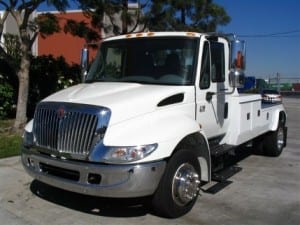
A wheel-lift tow truck raises either the front or rear wheels while the other wheels remain on the ground. It can be useful when a trailer cannot access the vehicle or when a short-distance tow is needed.
Wheel-lift towing may be appropriate when:
- The vehicle is in a tight location.
- A trailer cannot reach the car.
- The vehicle needs a short-distance tow.
- The vehicle can safely be lifted from one end.
A towing professional can determine which wheels should be lifted based on the vehicle’s drivetrain and condition.
Use a Flatbed Tow Truck
A flatbed tow truck is another alternative when you don’t want the vehicle being pulled behind another car. The entire vehicle is loaded onto the truck, keeping all four wheels off the road.
Flatbeds are often a good choice for:
- AWD vehicles
- 4WD vehicles
- Electric vehicles
- Severely damaged cars
- Vehicles with locked wheels
- Cars that cannot safely be towed with two wheels down
For many difficult towing situations, a flatbed is one of the safest options.
What Is the Best Method for a Dead Car?
If the car won’t start but the wheels roll and the steering works, several towing methods may be available.
A tow dolly may work if the vehicle is approved for it. A compatible flat-tow setup may also be suitable for vehicles specifically designed for four-down towing.
However, professional towing is usually preferable if the car has:
- Locked wheels
- Broken steering
- Severe accident damage
- Suspension damage
- Seized brakes
- Transmission problems
- AWD or 4WD restrictions
Can You Tow an Automatic Car Without a Trailer?
Sometimes. However, you must follow the manufacturer’s towing instructions.
Some automatic vehicles can be towed with certain wheels on the ground, while others require a dolly or flatbed. Incorrect towing can cause expensive transmission or drivetrain damage.
There is no universal rule that simply putting an automatic vehicle in neutral makes it safe to tow. Always check the owner’s manual for the exact year, make, model, and drivetrain.
Can You Tow an AWD Car Without a Trailer?
AWD vehicles require extra caution because all four wheels may be connected to the drivetrain. Towing with only two wheels on the ground can cause damage if the manufacturer does not approve that method.
When there are no specific manufacturer-approved alternatives, a flatbed tow truck is often the safest choice for AWD vehicles.

How Much Weight Can You Tow Without a Trailer?
The towing vehicle must be capable of safely handling the disabled vehicle and towing equipment.
Check:
- Maximum towing capacity
- Gross combined weight rating
- Hitch rating
- Tongue-weight rating
- Braking requirements
Also verify the weight ratings of the tow dolly, tow bar, tow strap, and other equipment. Never exceed the manufacturer’s limits.
Common Towing Mistakes to Avoid
DIY towing can become dangerous when unsuitable equipment or techniques are used.
Avoid:
- Using ordinary rope
- Exceeding towing capacity
- Ignoring the owner’s manual
- Towing AWD vehicles incorrectly
- Forgetting safety chains
- Failing to secure wheels
- Towing with damaged steering
- Driving too fast
- Making sudden turns
- Using damaged straps
- Attempting unsuitable highway towing
Taking time to check the equipment and vehicle requirements can prevent damage and accidents.
When Should You Hire a Tow Truck?
Professional towing is usually the better choice when you don’t have the correct equipment or aren’t sure how the vehicle should be moved.
Call a professional if:
- The vehicle has major damage.
- The wheels won’t roll.
- The car cannot shift into neutral.
- The steering doesn’t work.
- The vehicle is stuck.
- The car is AWD or 4WD and towing restrictions are unclear.
- The vehicle is an EV and towing instructions are uncertain.
- You don’t know the vehicle’s weight.
- You don’t have a properly rated towing vehicle.
A professional can choose the appropriate equipment and safely secure the vehicle.
Towing Methods Without a Trailer
| Method | Best Use | Main Concern |
| Tow dolly | Compatible vehicles | Drivetrain restrictions |
| Tow bar | Approved flat-tow vehicles | Vehicle compatibility |
| Tow strap | Short emergency movement | Steering and braking |
| Wheel-lift truck | Short-distance towing | Correct wheel placement |
| Flatbed truck | Damaged, AWD, or EV vehicles | Professional equipment needed |
Frequently Asked Questions
What is the easiest way to tow a car without a trailer?
For most disabled vehicles, hiring a professional wheel-lift or flatbed tow truck is the easiest option. For DIY towing, a tow dolly may work if the vehicle is compatible.
Can I tow a car with a rope?
A properly rated tow strap may work for certain short-distance emergency movements. An ordinary rope should not be used.
Can I tow a car with another car?
Yes, but the towing vehicle, equipment, and disabled vehicle must all be suitable for the towing method. Manufacturer instructions and local laws must also be followed.
Is a tow dolly better than flat towing?
Neither is universally better. A tow dolly works for certain vehicles, while flat towing is only suitable for vehicles approved for four-down towing.
Can I tow an AWD car with two wheels on the ground?
Not necessarily. Many AWD vehicles have specific towing restrictions. If two-wheel towing isn’t approved, a flatbed is generally the safer option.
What is the safest way to tow a car without a trailer?
For many disabled vehicles, a professional flatbed tow truck is one of the safest options because all four wheels remain off the road. This can be especially useful for AWD, 4WD, EV, and severely damaged vehicles.
Conclusion
You don’t necessarily need a trailer to tow a car. A tow dolly, approved tow bar, wheel-lift truck, or flatbed tow truck can all work depending on the vehicle and situation.
Always check the owner’s manual, stay within equipment weight limits, and avoid using unsuitable ropes, straps, or attachment points. If you’re unsure how your vehicle should be towed, professional towing is usually the safest and simplest solution.
Need Help Towing a Car?
If you don’t have the right equipment or aren’t sure how your vehicle should be towed, Towing Recovery Rebuilding Assistance Services can help.
Whether you’re searching for towing near me, towing Naperville, towing service, tow trucks, tow trucks Naperville, towing service near me, or tow trucks near me, professional assistance can help move your vehicle safely.
Call Towing Recovery Rebuilding Assistance Services at 630-200-2731 for towing assistance.
