

Yes, you can tow a broken-down vehicle, even if it will not start. The safest towing method depends on the vehicle’s drivetrain, weight, condition, ground clearance, and manufacturer recommendations. For many disabled vehicles, especially AWD vehicles, cars with transmission problems, damaged wheels, or accident damage, a flatbed tow truck is often the safest option.
Avoid using ropes, chains, or another vehicle unless the manufacturer’s instructions and local laws specifically allow it. Improper towing can damage the transmission, suspension, steering, or drivetrain and create dangerous conditions on the road.
Can a Broken-Down Car Be Towed?
Yes. A vehicle does not need to be running to be towed. Professional tow trucks can recover vehicles that:
- Will not start
- Have a dead battery or flat tire
- Have engine or transmission failure
- Have electrical or fuel problems
- Were involved in an accident
- Have locked or damaged wheels
- Cannot be safely driven
Depending on the vehicle’s condition, a tow operator may use a winch, wheel lift, dolly, or flatbed carrier.

What Is the Best Way to Tow a Broken-Down Vehicle?
For many disabled vehicles, flatbed towing is preferred because all four wheels remain off the ground. This reduces the risk of drivetrain damage and prevents the tires from rolling during transportation.
A flatbed is especially useful for:
- AWD and 4WD vehicles
- Vehicles with transmission problems
- Severely damaged vehicles
- Low-clearance cars
- Vehicles with wheel or suspension damage
- Cars that cannot roll normally
Always check the owner’s manual for specific towing requirements before choosing a towing method.
What Types of Tow Trucks Can Tow a Broken-Down Car?
Flatbed Tow Truck
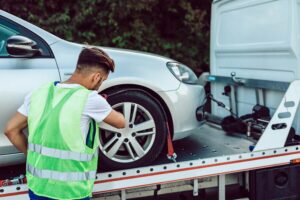
A flatbed tow truck uses a platform that lowers toward the ground. A non-running vehicle can be pulled onto the platform with a winch, secured, and transported with all four wheels off the road.
Flatbeds are commonly preferred for AWD vehicles, luxury cars, low-clearance vehicles, damaged vehicles, and cars with drivetrain problems.
Wheel-Lift Tow Truck
A wheel-lift truck raises either the front or rear wheels while the remaining wheels stay on the ground. This can be suitable for certain vehicles, but it is not appropriate for every drivetrain or condition.
Tell the towing company whether your vehicle is FWD, RWD, AWD, or 4WD and whether the transmission, steering, and wheels function normally.
Can You Tow a Car That Won’t Start?
Yes. A professional tow truck can transport a vehicle with engine, starter, battery, electrical, or fuel-system problems. A flatbed can use a winch to pull the vehicle onto the carrier.
When calling, explain whether the vehicle starts, moves, steers, and rolls normally. If the transmission is locked or the wheels will not move, mention this because specialized equipment may be necessary.
Can You Tow a Car With a Dead Battery or Flat Tire?
Yes. A dead battery generally does not prevent a vehicle from being towed. Depending on the situation, the operator may jump-start the car, winch it onto a flatbed, or use other appropriate equipment.
A car with a flat tire can also be transported. However, tell the dispatcher if multiple tires are flat, a wheel is damaged, the tire has come off the rim, or the steering is locked.
Can You Tow an AWD Vehicle?
Yes, but AWD vehicles require special attention. You should not assume an AWD vehicle can be safely towed with two wheels on the ground.
Some AWD systems can be damaged by incorrect towing procedures. A flatbed or manufacturer-approved dolly configuration may be required. Always tell the towing company that the vehicle is AWD and check the owner’s manual for proper towing instructions.
Can You Tow a Vehicle With a Damaged Transmission?
Yes, but the towing method matters. If the transmission has failed, leaving the driven wheels on the ground could cause additional damage.
A flatbed tow truck is often the safest option because it keeps the entire vehicle off the road. Tell the towing company about the transmission problem before the truck arrives.
Can You Tow a Car After an Accident?
Yes, although accident-damaged vehicles may require specialized recovery equipment. Tell the dispatcher if the vehicle has:
- Broken suspension or axles
- Locked wheels
- Steering damage
- Major body damage
- Leaking fluids
- Broken glass
- Deployed airbags
A severely damaged vehicle may need to be winched onto a flatbed rather than moved with a standard wheel lift.
Can You Tow a Car With Locked Wheels?
Yes, but additional equipment may be required. Locked wheels can result from seized brakes, transmission failure, steering problems, parking-brake issues, or accident damage.
Inform the towing company before arrival so the operator can bring appropriate dollies, skates, winching equipment, or other recovery tools.
Should You Tow a Broken-Down Car Yourself?
Usually, professional towing is the safer choice. Using a rope or chain can create problems with braking, steering, stopping distance, vehicle control, and drivetrain damage.
A professional tow truck is designed to secure and transport disabled vehicles while reducing risks to the vehicle and other road users.
What Should I Tell the Towing Company?
When requesting service, provide:
- Location: Exact address, highway, exit, direction of travel, or nearest intersection
- Vehicle: Year, make, model, color, and license plate
- Condition: Whether it starts, moves, rolls, steers, or has damaged wheels, tires, suspension, or transmission
- Drivetrain: FWD, RWD, AWD, or 4WD
- Destination: Repair shop, dealership, body shop, tire shop, or home
Accurate information helps the towing company send the right equipment and provide a more reliable estimate.
How Much Does It Cost to Tow a Broken-Down Vehicle?
Towing costs vary based on location, distance, vehicle size, time of day, and the type of recovery required. As a general planning range, a basic local tow may cost around $75–$150 for the base charge plus $2–$7 per mile, although actual prices vary by company and location.
| Factor | Possible Effect |
| Distance | Longer trips generally cost more |
| Vehicle size | May require heavier equipment |
| Vehicle condition | Damage may require additional recovery work |
| Location | Difficult access can increase costs |
| Time | After-hours service may cost more |
| Winching | May add recovery charges |
| Drivetrain | AWD/4WD may require specialized equipment |
Before authorizing service, ask for the estimated total cost, including mileage, equipment, and recovery fees.
How to Safely Wait for a Tow Truck
Your safety should come before your vehicle.
- Move to a safe location if possible.
- Turn on your hazard lights.
- Stay away from moving traffic.
- Contact roadside assistance or a towing company.
- Provide your exact location.
- Tell the dispatcher if you are on a highway or dangerous roadway.
- Follow the tow operator’s instructions when they arrive.
Avoid standing near a disabled vehicle on a busy or high-speed road unless necessary.
Can a Tow Truck Take My Broken Car to a Repair Shop?
Yes. A tow truck can typically transport your vehicle to an auto repair shop, dealership, tire shop, body shop, transmission shop, or home.
Provide the destination when you call so the towing company can estimate the cost and plan the appropriate transportation.
Flatbed vs. Wheel-Lift Towing
| Feature | Flatbed | Wheel Lift |
| All four wheels off ground | Yes | No |
| AWD-friendly | Often preferred | Depends on vehicle |
| Severely damaged vehicle | Excellent | May not be suitable |
| Non-running vehicle | Excellent | Depends on condition |
| Short local tow | Yes | Often convenient |
| Low-clearance vehicle | Usually suitable | Depends |
| Vehicle protection | Excellent | Good when properly used |
The correct option depends on the vehicle and its condition. Flatbed towing is not required for every car, but it is often preferred when drivetrain protection is important.
Frequently Asked Questions
Can I tow a car that won’t start?
Yes. Professional tow trucks can transport non-running vehicles using a winch, flatbed, or other appropriate equipment.
Can I tow a broken-down car with a rope?
Professional towing is generally safer than using a rope or chain. Improper towing can damage the vehicle and create serious traffic hazards.
Is a flatbed tow truck better for a broken-down vehicle?
Often, yes. A flatbed keeps all four wheels off the ground and is especially useful for AWD vehicles, drivetrain problems, severe damage, and vehicles that cannot roll normally.
Can you tow an AWD vehicle?
Yes, but the correct equipment is important. Some AWD vehicles require flatbed transportation or a manufacturer-approved towing configuration.
How much does it cost to tow a broken-down car?
A basic local tow may cost approximately $75–$150 plus mileage, but the final price depends on location, distance, vehicle condition, and equipment required.
Can a tow truck take my broken-down car to my mechanic?
Yes. You can request transportation to a repair shop, dealership, body shop, tire shop, or another suitable destination.
Conclusion
A broken-down vehicle can absolutely be towed, even when it will not start. Whether you have a dead battery, flat tire, engine or transmission failure, locked wheels, or accident damage, professional towing equipment can safely transport your vehicle.
Choosing the right towing method is important. Flatbed towing is often the safest option for AWD vehicles, severely damaged cars, non-running vehicles, and vehicles with drivetrain problems.
If you need towing, towing near me, towing Naperville, towing service, tow trucks, tow trucks Naperville, towing service near me, or tow trucks near me, contact Towing Recovery Rebuilding Assistance Services at 630-200-2731.
Whether you need a local tow, flatbed transportation, roadside assistance, or help getting a disabled vehicle to a repair shop, professional towing can help protect your vehicle and get you safely off the road.
